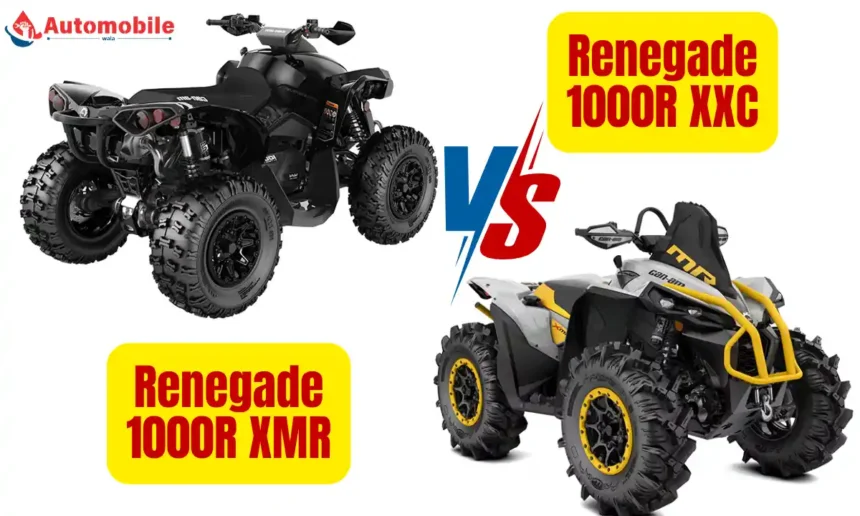
The Can-Am Renegade ATV series has built a strong reputation among off-road enthusiasts worldwide. Known for their power, performance, and rugged design, these ATVs are perfect for thrill seekers who love exploring challenging terrains. Among the Renegade lineup, the XXC and XMR models are the most talked about.
There are several ATVs in the Can Am Renegade 1000R lineup but XXC and XMR definitely stand out. Their unique features and different performances attract all kinds of ATV enthusiasts. If you are considering buying a Renegade ATV, it is important to understand what both of these models offer. This blog serves as a complete guide and comparison on “XXC vs XMR 2023”.
XXC vs XMR 2023 – Quick Overview
| Aspect | Renegade 1000R XXC | Renegade 1000R XMR |
|---|---|---|
| Launch Year | 2023 | 2023 |
| Target Riders | Balanced performance across multiple terrains | Best for extreme muddy and swampy conditions |
| Price (USD) | $15,949 | $17,249 |
| Popularity | Great for versatile off-roading | Dominates in mud & deep terrain |
Both ATVs share several core elements, including powerful engines and sturdy builds, but their design focus differs slightly. The XXC is ideal for riders who want a balanced ATV for multiple terrains, while the XMR is perfect for swampy, muddy conditions where higher ground clearance and aggressive tires are essential.
Detailed Specifications – XXC vs XMR
| Specification | Renegade 1000R XXC | Renegade 1000R XMR |
|---|---|---|
| Engine Type | Liquid-Cooled V-Twin | Liquid-Cooled V-Twin |
| Displacement | 976 cc | 976 cc |
| Horsepower | 89 HP | 89 HP |
| Torque | 67 lb-ft | 67 lb-ft |
| Drive Modes | 2WD / 4WD (Switchable) | 2WD / 4WD (Switchable) |
| Differential | Visco-Lok QE | Smart-Lok Differential |
| Front Suspension | Double A-Arm (9.2 in travel) | Arched Double A-Arm (9.2 in travel) |
| Rear Suspension | Torsional Trailing Arm (9.9 in travel) | Torsional Trailing Arm (9.9 in travel) |
| Ground Clearance | 10.5 inches | 11 inches |
| Front Tire Dimensions | 25×8-12 inches | 30×9-14 inches |
| Rear Tire Dimensions | 25×10-12 inches | 30×9-14 inches |
| Wheel Size (Front/Rear) | 12 inches | 14 inches |
| Towing Capacity | 1,300 lbs | 1,300 lbs |
| Handlebars | Adjustable | Adjustable |
Key Differences:
- The XMR has larger tires and higher ground clearance, making it better suited for extreme mudding.
- The XXC features a Visco-Lok QE differential, while the XMR gets the advanced Smart-Lok Differential for improved traction control.
- Price-wise, the XMR is $1,300 more expensive than the XXC.
Performance Comparison
| Performance Aspect | XXC | XMR |
|---|---|---|
| Speed & Balance | Smooth performance on multiple terrains | Slightly slower due to larger tires but better in deep mud |
| Traction | Good, but slightly less aggressive | Superior traction with Smart-Lok Differential |
| Maneuverability | Highly agile and easier to handle | Heavier feel due to bigger tires |
| Best For | General off-roading, rocky trails, and hills | Mud pits, swamps, and deep, soft terrain |
The XXC delivers a well-balanced ride, making it ideal for diverse terrains. On the other hand, the XMR is built for extreme off-road conditions, especially deep mud, thanks to its aggressive tires and higher ground clearance.
Suspension & Comfort
- XXC Model:
Features a Double A-Arm suspension, giving excellent balance on rough and uneven terrains. It’s designed for stability and comfort during longer rides. - XMR Model:
Comes with an Arched Double A-Arm suspension, which provides extra clearance for mud riding. This makes it perfect for extreme conditions but slightly stiffer for general trail riding.
Storage Space & Utility
Both models offer identical storage and towing capabilities, which is a huge plus for riders who need to carry tools or gear.
| Feature | XXC | XMR |
|---|---|---|
| Towing Capacity | 1,300 lbs | 1,300 lbs |
| Front & Rear Racks | Spacious | Spacious |
| Additional Storage | Glove box, under-seat compartment | Glove box, under-seat compartment |
Both ATVs are equally practical for carrying supplies, camping gear, or rescue equipment on long off-road trips.
Reliability & Maintenance Costs
The XXC and XMR are both extremely reliable due to Can-Am’s robust engineering.
- Their powerful engines and high-quality build make them dependable for long-term use.
- Maintenance costs are reasonable since parts are easily accessible for servicing.
- Typical servicing includes:
- Oil changes
- Air filter cleaning
- Complete vehicle inspection
Both models are designed for low-maintenance ownership, which makes them ideal for frequent off-road riders.
Pricing – XXC vs XMR
| Model | Price (USD) |
|---|---|
| Renegade 1000R XXC | $15,949 |
| Renegade 1000R XMR | $17,249 |
The XMR costs about $1,300 more, which is justified by its larger tires, higher ground clearance, and advanced differential system.
Which One Should You Choose?
- Choose XXC If:
- You need a versatile ATV for multiple terrains.
- You prefer better speed and handling.
- Budget is a priority.
- Choose XMR If:
- You regularly ride in mud, swamps, or extreme off-road conditions.
- You need maximum ground clearance and aggressive traction.
- Price isn’t a major concern.
FAQs
How much extra ground clearance does the XMR have?
The XMR offers 11 inches of ground clearance, compared to 10.5 inches on the XXC.
Which model is more expensive?
The XMR costs $17,249, while the XXC is priced at $15,949.
Do both models have the same towing capacity?
Yes, both have an impressive towing capacity of 1,300 lbs.
Conclusion
The Can-Am Renegade 1000R series delivers exceptional performance for off-road adventures. While both the XXC and XMR are powerful machines, they cater to different riding needs:
- The XXC is a balanced, all-terrain performer, offering great speed and maneuverability.
- The XMR, with its aggressive tires and higher clearance, excels in muddy, swampy terrains.
If you’re an extreme thrill seeker, the XMR is worth the extra cost. However, if you want a versatile and budget-friendly option, the XXC is a fantastic choice.
Also read about: R15v5 Price in India & Launch Date, Engine Specifications, Features, Mileage, & More